New Delhi: The year 2025 unfolded as one of profound turbulence and transformation on the global stage. Marked by intensifying wars, political upheavals, rapid technological breakthroughs, climate extremes, and moments of unexpected progress, the world oscillated between crisis and resilience. From the grinding battlefields of Ukraine and Gaza to the race for artificial intelligence supremacy, and from assassinations that shocked democracies to rare environmental victories, 2025 became a year that tested global stability while redefining power, governance, and survival in an interconnected world.
At its heart, 2025 was a year of contradictions. Armed conflicts escalated even as diplomacy sought fragile ceasefires. Democratic institutions were shaken by violence and polarisation, while technological innovation surged ahead at an unprecedented pace. Climate alarms grew louder, yet conservation efforts delivered rare positive signals. As billions of people watched unfolding events through screens and social media, the year’s headlines collectively shaped a narrative that will influence global trajectories well beyond 2026.
Politics and Conflicts: A World on Edge
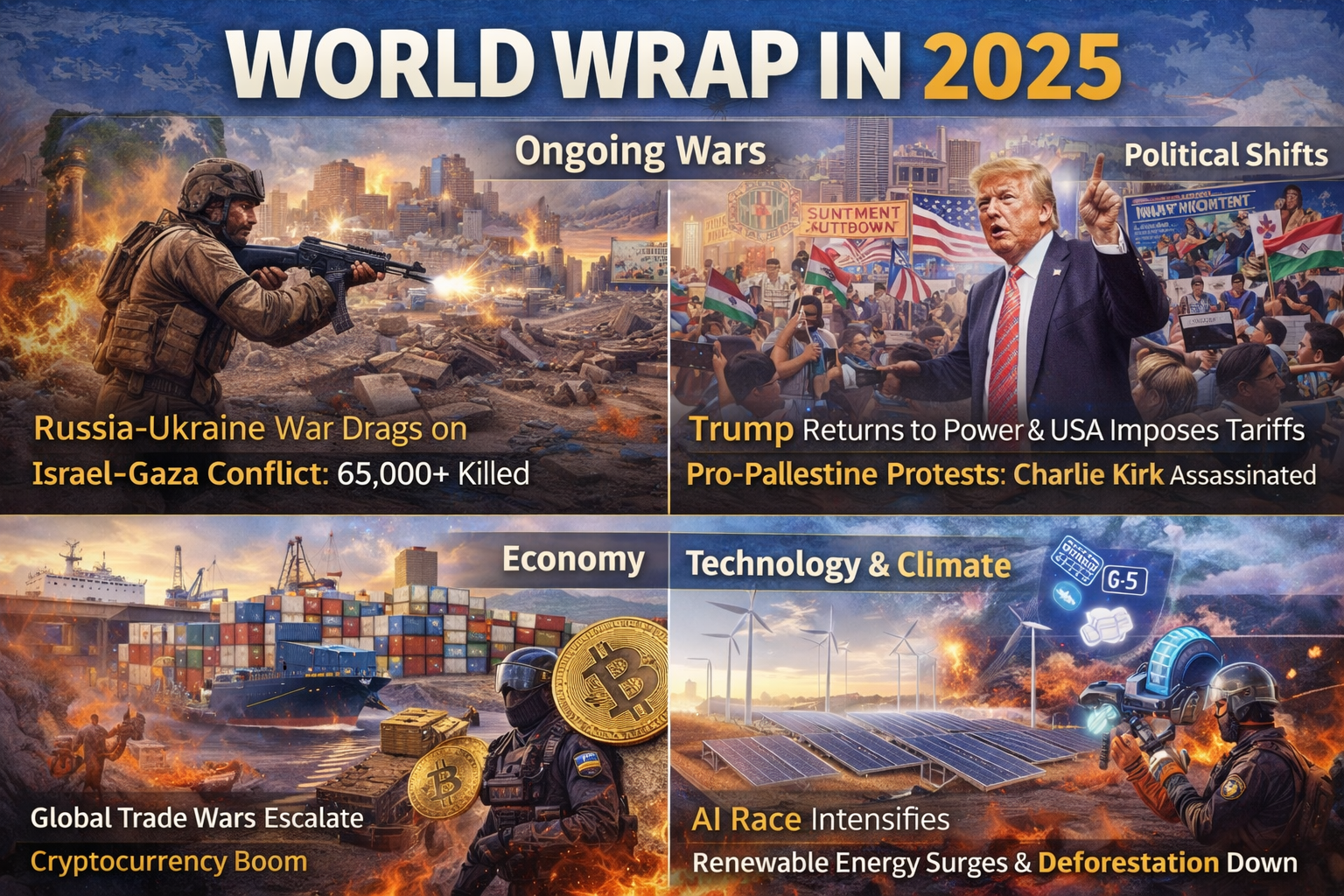
The geopolitical landscape of 2025 was dominated by war and uncertainty. The Russia-Ukraine conflict entered its fourth relentless year, hardening battle lines and exhausting diplomatic efforts. In March, Russia reclaimed its Kursk province following Ukraine’s incursion in late 2024, reinforcing Moscow’s territorial grip even as Ukrainian cities faced intensified missile and drone strikes. Civilian casualties mounted, infrastructure was repeatedly targeted, and the humanitarian toll deepened.
Ukrainian President Volodymyr Zelenskyy continued to project confidence in sustained Western support, particularly from the United States, but the absence of a decisive breakthrough underscored the war’s entrenched nature. The prolonged conflict continued to destabilise energy markets, strain NATO unity, and reinforce the global sense that modern warfare had entered a prolonged era of attrition.
In the Middle East, the Israel-Hamas conflict reached devastating new levels. By September, Israeli forces had advanced into Gaza City, pushing the Palestinian death toll beyond 65,000. Mass displacement, humanitarian collapse, and global outrage followed, while pro-Palestinian protests erupted worldwide—often facing heavy-handed repression. Antisemitic incidents surged globally, highlighting the conflict’s far-reaching social consequences.
A U.S.-brokered Gaza peace plan, approved by the United Nations Security Council in November, offered a rare diplomatic opening. However, its implementation remained deeply contested amid ongoing clashes and mutual distrust, leaving the region teetering between fragile hope and renewed escalation.
Elsewhere, South Asia witnessed renewed tensions as India and Pakistan clashed, reinforcing the volatility of a nuclear-armed region. Sudan’s civil war dragged on with brutal consequences, displacing millions and worsening one of the world’s gravest humanitarian crises. Across Africa, a series of coups disrupted fragile democracies, while in Nepal, Gen Z-led protests forced the resignation of Prime Minister K.P. Sharma Oli—signalling the growing political influence of younger populations.
Elections, Power Shifts, and Political Violence
Elections reshaped political landscapes across continents. Venezuela’s legislative elections in May dominated global media discourse, attracting millions of mentions amid concerns over democratic erosion. Argentina’s October polls delivered a decisive victory to President Javier Milei’s La Libertad Avanza party, consolidating a radical libertarian experiment in Latin America.
In Europe, Albania’s Socialist Party secured re-election, while Czechia’s ANO party emerged as the largest bloc without securing a majority. Moldova’s pro-European PAS party triumphed, reinforcing the country’s westward political orientation. Syria conducted its first parliamentary election following the Assad era, marking a symbolic—if tentative—political transition.
In the United States, politics took a dramatic turn with the return of President Donald Trump to the White House. His administration quickly dominated headlines, revealing covert CIA operations in Venezuela and triggering diplomatic fallout. Trump’s leadership style, once again disruptive and confrontational, reshaped both domestic politics and international alliances.
The year was also scarred by political violence. In September, conservative activist Charlie Kirk was assassinated during a campus event in Utah, sending shockwaves through American political circles. In Minnesota, state representatives Melissa Hortman and John Hoffman were targeted in shootings, underscoring growing threats to elected officials. December witnessed a mass shooting at Sydney’s Bondi Beach, killing dozens in an attack linked to antisemitism, prompting calls for federal investigations and reigniting debates on extremism and gun violence.
Economy and Trade: Tariffs, Trade Wars, and Realignments
Economic policy became a defining force of global headlines in 2025. President Trump’s aggressive trade stance reshaped international commerce almost immediately. In March, the United States imposed 25 per cent tariffs on imports from Mexico and Canada and raised duties on Chinese goods to 20 per cent. Retaliatory measures from Canada and China followed swiftly, reigniting fears of a full-scale trade war.
Trump further stunned global audiences by declaring his intention to acquire Greenland “one way or the other” during a record-breaking 99-minute address to Congress. These moves, coupled with legislative deadlock, contributed to a U.S. government shutdown—one of the year’s most searched and discussed events.
China, meanwhile, posted a record trade surplus of $990 billion in January and accounted for nearly one-third of global manufacturing output. Despite economic slowdowns, China achieved a rare milestone: emissions appeared to plateau, with a reported one per cent decline—fueling cautious optimism among climate analysts.
Elsewhere, Uzbekistan expanded its international profile by hosting major diplomatic summits, while South Africa reinforced its global standing after hosting the G20, Rugby World Cup, ICC World Cup, and Netball World Cup in recent years.
The cryptocurrency and blockchain sector experienced explosive growth. The TON ecosystem emerged as a global financial force, featuring U.S. exchange listings, gasless transactions, and tokenised U.S. stocks. Decentralised finance infrastructure expanded rapidly, with firms like Rayls Labs securing major funding rounds.
Science and Technology: The Age of Artificial Intelligence
Technology, particularly artificial intelligence, defined 2025’s innovation narrative. OpenAI’s release of ChatGPT-5 in August marked a major leap in reasoning and problem-solving capabilities, igniting renewed debates about automation, ethics, and workforce disruption. Google’s Gemini AI dominated global search trends, reflecting intensifying competition among tech giants.

China made landmark scientific advances, including its “artificial sun” EAST sustaining temperatures of 100 million degrees for over 1,000 seconds—a breakthrough in nuclear fusion research. The unveiling of the Zuchongzhi 3.0 quantum computer further signalled Beijing’s ambition to lead next-generation computing.
Other breakthroughs included progress in brain-computer interfaces, high-precision semiconductor chips, and new insights into the moon’s far-side geological history. Esports exploded in China, with nearly 495 million users and revenues touching $29.3 billion, cementing gaming as a cultural and economic powerhouse.
In Africa, Nigeria’s tech ecosystem pivoted toward a digital-first economy, attracting $150 million in investment and positioning itself as a rising innovation hub.
Climate and Environment: Crisis Meets Cautious Progress
Climate change remained an omnipresent theme. The year tied as the second-warmest on record, with extreme weather events dominating headlines. COP30 faced global criticism after failing to explicitly address fossil fuels, with environmental groups branding it an “abject failure.”
Yet amid grim warnings, positive developments emerged. Global deforestation declined, solar energy adoption surged, and rivers once declared ecologically dead showed signs of revival. A non-binding international court ruling established new benchmarks for climate accountability, while conservation efforts expanded protected habitats for species such as koalas.
Disasters, however, underscored the urgency of action. California’s Eaton Fire, South Korea’s deadly Uiseong wildfire that claimed 30 lives, and the grounding of iceberg A23a illustrated the escalating consequences of a warming planet.
Sports, Culture, and Soft Power
Sports and culture offered moments of unity and celebration. The United States clinched the IIHF World Championship, while Inter Miami, led by Lionel Messi, lifted the MLS Cup. China’s 15th National Games and a grand World War II Victory Day parade showcased cultural nationalism and historical remembrance.
In popular culture, the engagement of Taylor Swift and Travis Kelce captivated global audiences, while Beyoncé’s Cowboy Carter won Grammy Album of the Year. Music charts reflected a year of genre-blending and global influences.
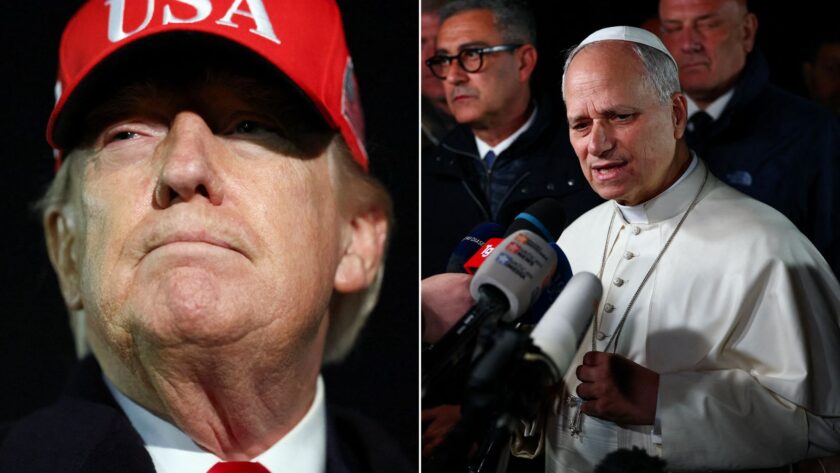
The Vatican mourned the death of Pope Francis, followed by the election of Pope Leo XIV—whose ascension broke long-standing traditions and signalled shifts within the Catholic Church.
Human Costs, Crises, and Social Shifts
Tragedy remained a recurring theme. Aviation incidents—including an Air India crash and a mid-air collision over the Potomac—shocked the public, though global accident rates did not spike overall. Heathrow Airport suffered a major blackout, disrupting travel for over 270,000 passengers.
Humanitarian crises persisted in Gaza and Sudan, while Australia implemented a strict social media ban for users under 16, aiming to curb digital harm and mental health risks.
Rays of Hope Amid the Chaos
Despite turmoil, 2025 delivered moments of hope. Scientists successfully treated previously incurable diseases, endangered species rebounded, and China’s Ne Zha 2 emerged as a global box office sensation. Istanbul hosted pivotal summits on global conflicts and economic cooperation, while incremental advances in human rights emerged in select regions.
A Defining Year for the Future
The year 2025 tested the resilience of nations and societies alike. As wars raged and political divisions deepened, innovation, diplomacy, and grassroots movements offered counterweights to despair. President Trump’s return to power reshaped global discourse, while breakthroughs in AI, climate science, and medicine hinted at transformative possibilities.
Ultimately, 2025 reinforced a sobering reality: the world’s challenges are deeply interconnected. Conflict, climate, technology, and governance no longer operate in isolation. The decisions made—and avoided—during this turbulent year will reverberate well into the next decade.
As the world steps into 2026, the lessons of 2025 remain clear and urgent: cooperation is no longer optional, resilience must be collective, and the future will be shaped not just by power, but by responsibility.